Originally posted in German on 29th January 2026
by Heinz Grill
Typical ritualistic acts have a widespread existence in various religious ceremonies, for example in the eucharistic mass of the catholic church. In the epiclesis, through the assembly of the congregation and priest’s act of consecration, the so-called holy spirit is called into the eucharistic bread and this is then distributed to the members of the church.
Normal ritualistic acts are intended to guide a spiritual reality into the earthly and exude a holy atmosphere. However, regardless of whether these acts take place in the fire rituals of yoga, the puja, or in a Christian context, experiences show that they can ignite hardly any purifying force or a spiritual impulse. The power to call the spiritual to the earth was greater in earlier times as people then experienced an intrinsic view of the cosmic forces and were therefore better able to direct them ritually. With the loss of spiritual clairvoyance, the ceremonial power of the traditional rites has disappeared.
In the spiritual academy in Naone there are no ceremonies, no worshipful rituals, no ritualistic acts and no acts of praise such as bowing or communal prayers of supplication. Rather, in the courses, there is the completely natural basis of what Rudolf Steiner termed “reverse cult”.1) Rudolf Steiner spoke about a reversed cult in a lecture he gave on Building Community on 3rd March 1923 in Dornach, “Is truth involved when we talk of the super-sensible world, yet are unable to rise to awareness of a spiritual presence and of this reversed cultus? We are firmly grounded in our understanding of things of the spirit only when we do not rest content with abstract spiritual concepts and a capacity to express them theoretically, but instead grow into a sure belief that higher beings are present with us in a community of spirit when we engage in spiritual study. No external measures can bring about anthroposophical community building. You have to call it forth from the profoundest depths of human consciousness.” (GA257 Lecture 6, Para 27) While ceremony aims to call the spirit from above to below, conscious work with content-based researching of knowledge can perceive the spiritual reality and, to a certain extent, manifest it from below to above. This does not require a priest to conduct an act of consecration, but rather people who orientate themselves together and undertake researching, working on and investigating an insight.
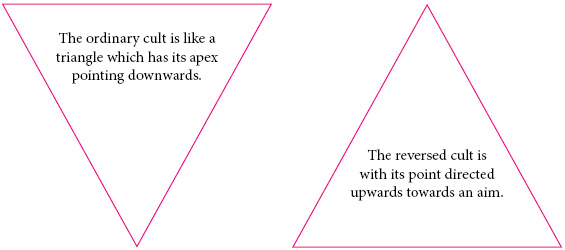
However, this reverse cult remains a kind of mystery to the modern intellectual person because its success presupposes a sincere attitude and requires an act of self-overcoming by the ‘self’, „saṁstabhyā ‚tmānam ātmanā“ (Bhagavad-Gita ch. 3 v. 43) and an insight into, even knowledge of the intrinsic and so meaningful cycle of sacrifice. 2)The Bhagavad-Gita speaks about sacrifice in Chapter 3 Vers 12:
iṣṭān bhogānhi vo devā dāsyante yajñabhāvitāḥ
tairdattānapradāyaibhyo yo bhuṅkte stena eva saḥ
Fostered by sacrifice the gods shall give you desired enjoyments: who enjoys their given enjoyments and has not given to them, he is a thief.“
(From Sri Aurobindo Essays on the Gita).
Practical work of meditation in a common direction, which is connected with the spirit of bhakti – that is, the spirit of turning to a thought of content – is foundational for this. If the statements made by the teacher were only taken and intellectually accumulated, a situation that is unfortunately very common in many branches of spirituality, no bhakti, no actual loving worship with the power of spiritual reconciliation can occur. 3)For the role of bhakti in the research of insight also see the article: Caution Cult – part 3. If people want to insightfully comprehend a statement, they must learn to turn intensively to the author who has coined the words. This ‘turning to’ can happen in two ways: it can be directed towards the author or teacher and furthermore to their words. Those who want to understand Goethe, cannot only learn his poems by heart, they have to turn to Goethe, comprehend him spiritually, experience him in the sense of bhakti, lovingly veneration, in order to penetrate his words from the inside out. Through this deep work of turning towards people, their spiritual authorship and words, the cult reverses in a meaningful way to become a constructive spiritual-stream and source of spiritual strength.
Both individual personalities, through the flaming application of their forces, can comprehend, experience and bring towards the spirit the truths from spiritually informed statements, and also a whole group can practice applying an insight usefully not only for themselves, but also enlivening it into etheric forces and ultimately bringing it into world creation.
The Reversed Cult is practiced quite naturally in this spiritual school by individuals who have already developed an initial clairvoyance. The success of this joint work of insight and conscious turning towards both the content and the creators of spirit bestow a profoundly purifying sphere with a healing character. Many people have already experienced significant improvements in their health and discovered life prospects that lead to joyful development through this practice. Furthermore, the meteorological atmosphere gains a palpable enhancement.
Unfortunately, this work is viewed with great contempt by anthroposophists, and many who participate in it constantly face unfounded criticism. For example, the term ‘reverse cult’ is said to be reserved for anthroposophists, and furthermore the yoga is definitely anti-Christian and anachronistic. However, what is a real yoga? Yoga consists of three main limbs: jnana yoga, the discipline that seeks and strives for knowledge; bhakti yoga, turning to the great personalities and perceiving their existence and their relationship to the spiritual world in a concentrated work of meditation. bhakti yoga excludes materialism and is by no means to be confused with subservience. Those who want to study the gospels or the Bhagavad-Gita or seek to experience Rudolf Steiner profoundly need the spirit of bhakti and to raise their will out of all intellectual knowing and explore a truth that exists in the world creation. Finally, the third discipline of yoga is karma yoga or more generally, the yoga of action, which leads an idea that has been sufficiently comprehended into a solid, logical mental-picture and, then, through sustained effort, practically incorporates it into societal life.
The various breathing processes, physical disciplines and soul exercises that are practiced in the Sun Oasis, serve the pursuit of knowledge, the development of greater concentration and devotion and, ultimately, the capacity for practical artistic expression. Beyond this, however, they constitute a discipline that transcends the personal and offers an opportunity to come closer to a spiritual atmosphere. Through their thematic-spiritual direction, they are part of the Reversed Cult. However, because they evidence content led, logical and practical connections, they do not appear overtly as ritualistic practices.
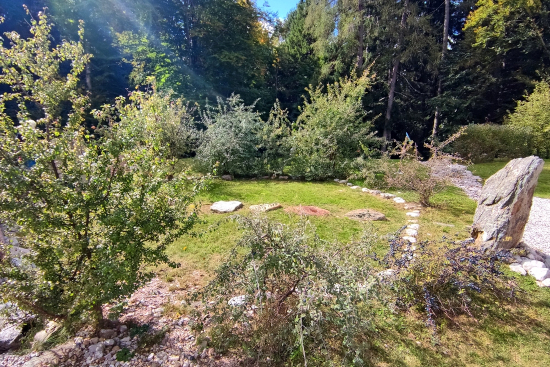
This photo was taken after a seminar has ended. The atmosphere clearly shows a lively play of light and the elemental nature spirits attained a visible, liberating joy.
Photo: Ulrike Sinzinger
Anmerkungen
| ⇑1 | Rudolf Steiner spoke about a reversed cult in a lecture he gave on Building Community on 3rd March 1923 in Dornach, “Is truth involved when we talk of the super-sensible world, yet are unable to rise to awareness of a spiritual presence and of this reversed cultus? We are firmly grounded in our understanding of things of the spirit only when we do not rest content with abstract spiritual concepts and a capacity to express them theoretically, but instead grow into a sure belief that higher beings are present with us in a community of spirit when we engage in spiritual study. No external measures can bring about anthroposophical community building. You have to call it forth from the profoundest depths of human consciousness.” (GA257 Lecture 6, Para 27 |
|---|---|
| ⇑2 | The Bhagavad-Gita speaks about sacrifice in Chapter 3 Vers 12:
iṣṭān bhogānhi vo devā dāsyante yajñabhāvitāḥ Fostered by sacrifice the gods shall give you desired enjoyments: who enjoys their given enjoyments and has not given to them, he is a thief.“ (From Sri Aurobindo Essays on the Gita). |
| ⇑3 | For the role of bhakti in the research of insight also see the article: Caution Cult – part 3. |