Originally posted in German on 23rd August 2026
This yoga position, that is known as the king of asanas, as the rāja-āsana, opens a very beneficial and comprehensive healing effect for people. For more or less healthy people, learning to stand on the head in an inverted posture can constitute an excellent discipline, that gifts life, the psyche and the whole posture with what are known as ‘forces that build form’.1)In Anthroposophy, shape forming forces are generally defined in relation to silicic acid and the silica processes, a process that takes place through the activity of thinking and concentration.
What are form-building forces, or put another way, structure-forming forces? Both for people who are young as well as those who are not so young, learning the head stand, standing inverted with the head downwards and the feet upwards, requires a long phase of preparation, practice (either alone or with a teacher) and persistent repetition. Both balance and a stable, aligned position2)In general, picturing a vertical line in the headstand can be very helpful. Standing in the inverted form enables this vertical dynamic to be experienced in a particularly impressive way. must find its expression, coordination and strength through the development of the muscles of the shoulders, the lumber spine and also the abdominal region. The brain is supplied with fresh blood and nearly all areas begin to rejuvenate as a result. It is a kind of thought-force that practitioners must employ in the development of this position, which is challenging for the average person. Thoughts and movement must be coordinated. Initially the position is unstable, uncertain, sometimes fraught by anxiety; the legs feel their way against gravity into a vertical line and the shoulders, with the crown that has been placed on the floor, seek a stable, calm base. Slowly, yet with increasingly clear and precise coordination, the position gains expression, form and stability. The head stand exhibits structure in its final form; the process of learning it likewise requires a structured and very conscious approach. The practice requires a clear approach, that must follow the movement as well as the conscious forming of a mental picture. Repeatedly aligning the body into an inverted position creates an initial sense of achievement. The body is brought into a new, carefully chosen form.
Forces that build form and structure are particularly beneficial to health, as they provide the psyche with stability and give the body a beautiful appearance. A life lived mainly without discipline leads with time to processes of softening and disintegration throughout the whole organism; and both the internal organs weaken in their function, and the nervous system gradually loses a healthy and viable sensibility. People often lack discipline and forming required for life; consequently depression, states of weakness, and various unnecessary feelings of vulnerability result, stemming not from too many demands but from a lack of meaningful demands or senseless, exhausting idleness. One-sided intellectual overstimulation generates no form-shaping forces because it has a passive effect on people, much like fluorescent lighting in a large hall.
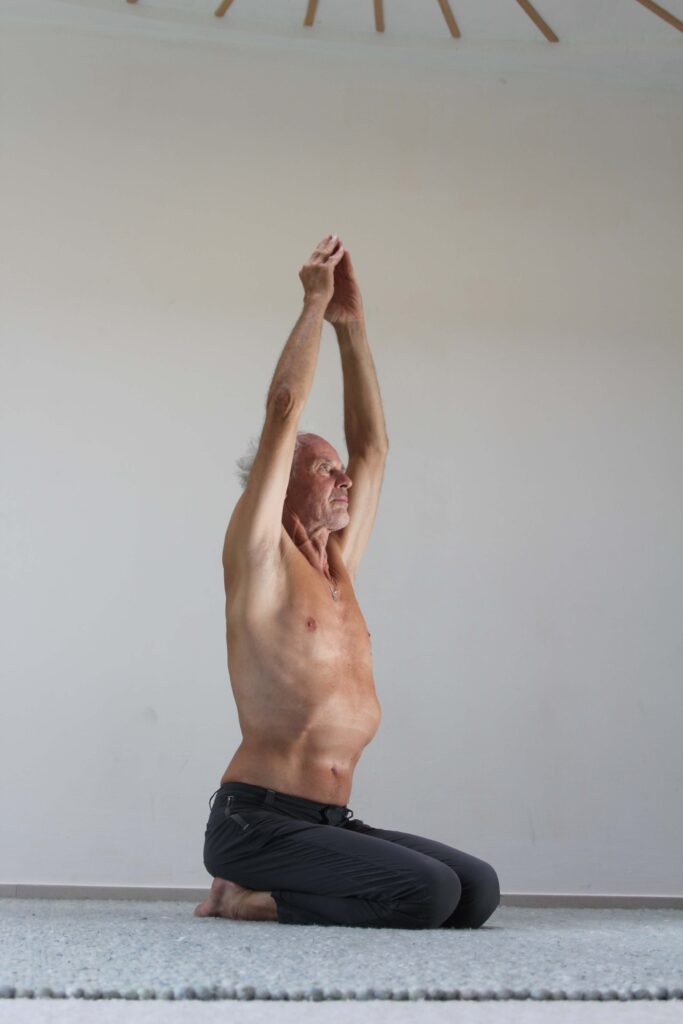
A simple form of the vertical line can be experienced in a kneeling position through straightening up the upper body.
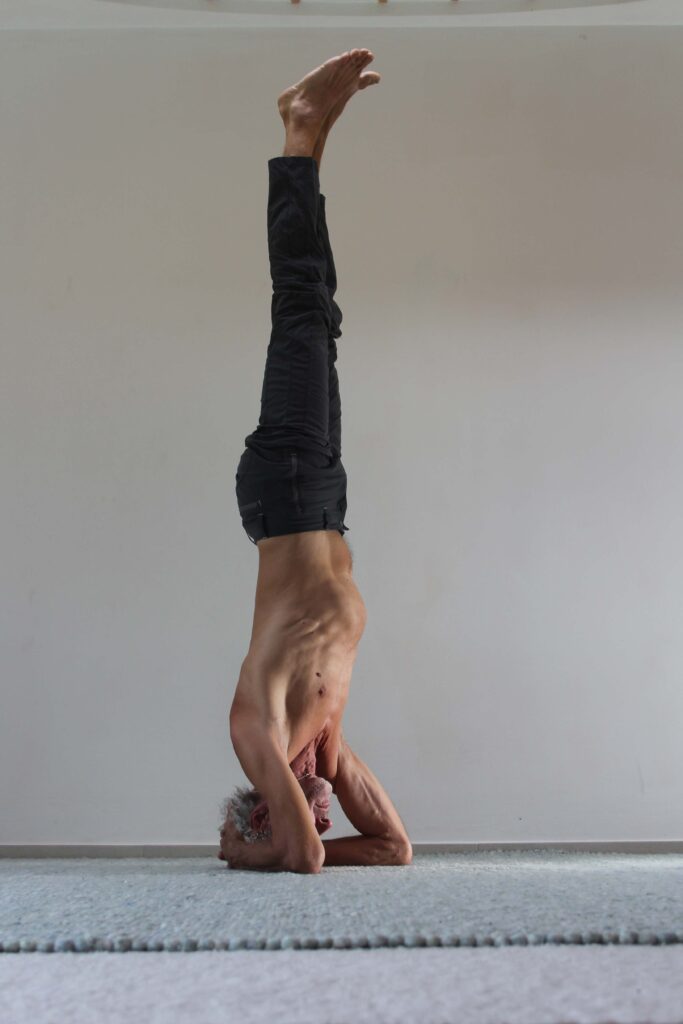
The classic shirshasana3)Śīrṣāsana if translated literally means ‘the position on the head’, śīrṣā means ‘head’ and āsana means ‘posture’. In Italian this position is called ‘La verticale sulla testa’, translated as ‘vertical line on the head’. position establishes a stable base using the arms and interlaced fingers to support the back of the head. The body rests precisely on the crown of the head.
People today urgently need an activity in which they can realise an idea in practical life. The head stand as a position can constitute a simple idea to learn. The way to realise this unusual position in the practice can unfold step by step. The body is given a new form. In general, however, the activity of successfully bringing an idea into a mental picture, experiencing it in the feelings and ultimately bringing it into the practice, has the effect of strengthening the form creating forces on the body.
There is already an article describing the head stand and its variations, it is highly recommended for developing a yoga practice and also for gaining further insight into the yoga technique. It can be found here.
With eye or ear disorders, high blood pressure or with damaged cervical disc, the head stand should not be practiced without medical consultation.
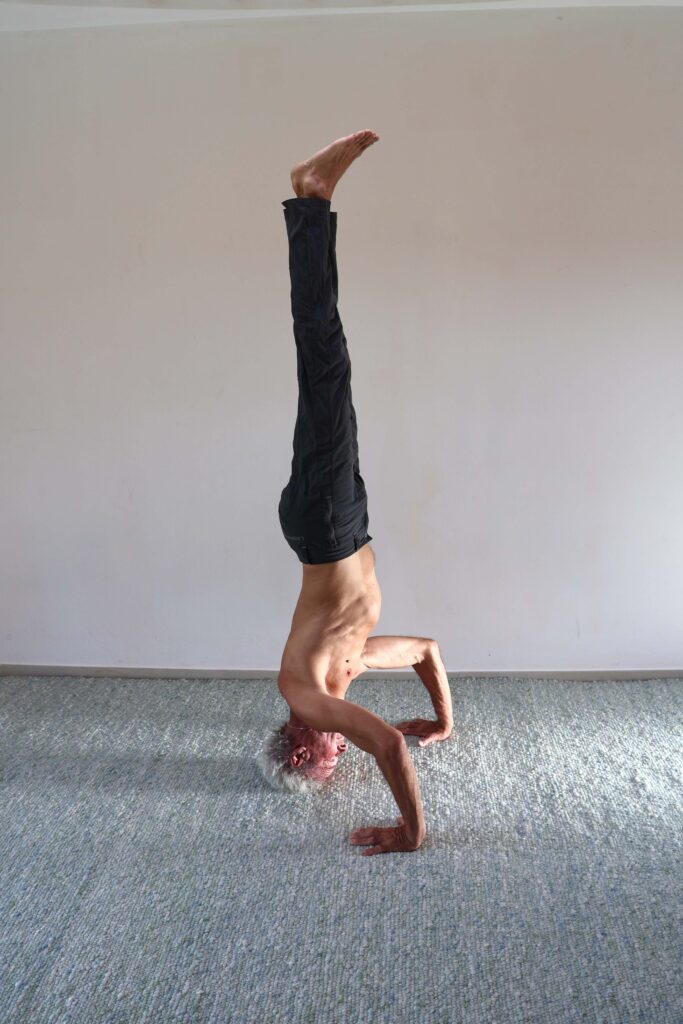
A playful variation of this position involves forming a triangle form on the ground. The positioning of the head is veering towards the forehead, while the hands form a triangle with the head, determining the balance.
Anmerkungen
| ⇑1 | In Anthroposophy, shape forming forces are generally defined in relation to silicic acid and the silica processes, a process that takes place through the activity of thinking and concentration. |
|---|---|
| ⇑2 | In general, picturing a vertical line in the headstand can be very helpful. Standing in the inverted form enables this vertical dynamic to be experienced in a particularly impressive way. |
| ⇑3 | Śīrṣāsana if translated literally means ‘the position on the head’, śīrṣā means ‘head’ and āsana means ‘posture’. In Italian this position is called ‘La verticale sulla testa’, translated as ‘vertical line on the head’. |