Originally posted in German on 24th April 2026
by Heinz Grill
The anāhata-cakra sometimes referred to as the twelve petaled lotus flower at the heart, defines itself above all through a consciousness of universally valid content. What is a content? In an allegorical comparison, a glass is the outer form and the liquid within it the content. In human beings, the outer stature, in its sensory appearance, shows the world of the body, whereas the invisible and developed consciousness of the human being depicts the soul, and to a certain extent, represents the content of their life. However, all content or soul existence in human nature originates from the spirit and possesses an otherworldly existence.
The more the content of someone’s soul life takes on a universal validity, the more the heart centre is cultivated as a soul quality within the person. A universal reality gains, via this chakra, that lies in the middle of the chest, an individual position, which, however, does not express a part that stand alone but leads to the manifestation of a universal whole. In the heart centre, when it is effectively developed, the human being perceives their own individual nature in the best sense of a greater whole.
This logic, which describes how universal or spiritual existence interacts with the earthly, individual life is immanent in human beings. For this reason, the logic that give rise to human existence must not be too formal and limited in scope. Now, it may be that someone in their spiritual development does not start from this basic logical order, but instead forms conclusions from a material plane that excludes the whole, for example saying: “The content of the meditation pleases me, I like it and therefore I will claim it for my own personal feeling.” This and similar formulations exist in many esoteric groups or religious gatherings. They describe a form of consuming that is not related to food or material goods, but to spiritual content. It is not primarily the engagement with and dedication to spiritual content that lives, but rather a personal appropriation of it, which creates a shadow-spectre that removes the spiritual content from its original aliveness and suffocates it within the body.
Through a spirituality that is oriented towards consuming both the head and the middle of the chest take on take on a shadow-like form, which shields people from the cosmos and from forming deeper connections to their fellow human beings. The sacrifice of real engagement is missing, as well as, the living spirit of bhakti – loving devotion and dedication. A meditation can never bear fruit if the human consciousness alters the logic of development in the approach to spiritual content. Spiritual thoughts cannot, in fact, be used like a cooking recipe.
Rudolf Steiner attributes particular importance and high value to logic as the first point in the unfolding of the heart centre. However, what logic is meant? Is it merely formal logic, which compares one worldly position with another, or is it the symbolic logic of mathematics? Rudolf Steiner elaborates very little on his thoughts regarding logic, so the reader could very easily confuse the engagement with content and logical consideration of the laws pertaining to the spiritual world with a purely formally determined logic that takes into account only material circumstances.1) The following text can be read in Rudolf Steiner’s “The knowledge of the higher worlds and its attainment.”:
“Just as the sixteen-petalled lotus is developed by cultivating thoughts that conform with truth and are significant, so, too, the twelve-petalled lotus is developed by inwardly controlling the trains of thought. Thoughts that dart to and fro like will-o’-the-wisps and follow each other in no logical or rational sequence, but merely by pure chance, destroy its form.”
The thoughts must be true and consistent with the signature or the theme and not remain merely as they are, but come further into realisation, into formulation, into consequences and be shaped practically in society. If you now read further in Rudolf Steiner’s text and do not take into account this context of true thought, that means also of true content, the following sentences could be misleading.
“The closer thought is made to follow upon thought, and the more strictly everything of illogical nature is avoided, the more suitable will be the form this sense organ develops.”
It is therefore important to be aware that the true thought and the content that human beings cultivate in a true and universal way, stand at the centre of the whole development, and the heart lotus only develops out of this.

At first it appears totally contradictory and illogical for a spiritual seeker who wants to practice meditation with a body-free consciousness to be carrying out at the same time physical exercises, known as asana, as part of their practice. Yes, at first this mental picture does seem illogical. However, as the spiritual practitioners continue to engage with the content and learn to carry this over into their practice with the body, they begin to develop a greater body freedom. They practice with their body whilst simultaneously freeing their consciousness from all heaviness and physical constraints.
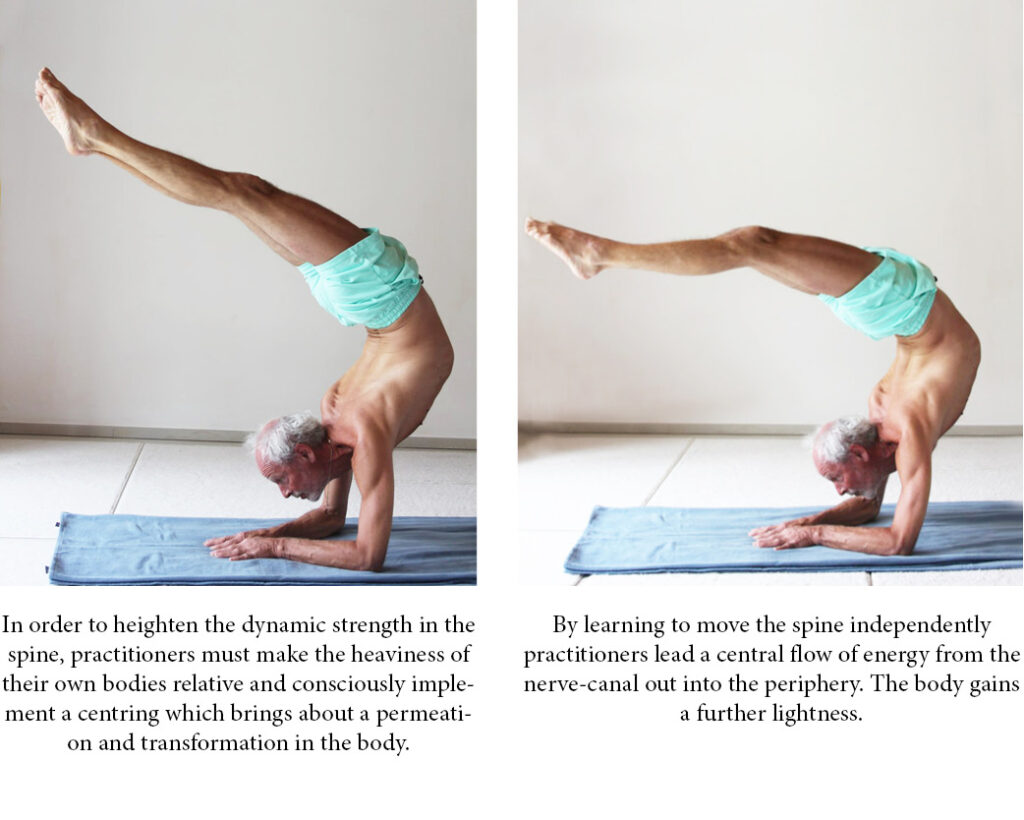
The logic of body freedom is not directly dependent on the activity with the body. The more spiritual students learn to be consciousness of how the body and all material situations can be guided through a clear engagement with content, the freer they become from the physical. The body becomes transformed. The practice gains a logic for the whole of development and for meditation work and this even becomes a gift to world creation.
Logic develops out of an engagement with content that is as founded as possible, and it becomes not only formal but integral.

The owl is largely associated with negative connotations, as it is a nocturnal bird. It brings thoughts into play, however, these thoughts have already become a part of history. In a sense, it repeats history. Therefore, its wisdom is not a revelatory wisdom but a repetition of past forms that accompany life as wisdom.

Both drawings: Yva Ev

Drawing: Anne-Michèle Hambye
Anmerkungen
| ⇑1 | The following text can be read in Rudolf Steiner’s “The knowledge of the higher worlds and its attainment.”:
“Just as the sixteen-petalled lotus is developed by cultivating thoughts that conform with truth and are significant, so, too, the twelve-petalled lotus is developed by inwardly controlling the trains of thought. Thoughts that dart to and fro like will-o’-the-wisps and follow each other in no logical or rational sequence, but merely by pure chance, destroy its form.” The thoughts must be true and consistent with the signature or the theme and not remain merely as they are, but come further into realisation, into formulation, into consequences and be shaped practically in society. If you now read further in Rudolf Steiner’s text and do not take into account this context of true thought, that means also of true content, the following sentences could be misleading. “The closer thought is made to follow upon thought, and the more strictly everything of illogical nature is avoided, the more suitable will be the form this sense organ develops.” It is therefore important to be aware that the true thought and the content that human beings cultivate in a true and universal way, stand at the centre of the whole development, and the heart lotus only develops out of this. |
|---|---|
| ⇑2 | Georg Friedrich Hegel, Philosophy of Right (1821), translated by H.B. Nisbet 1991 |
| ⇑3 | In ancient times, from which the Bhagavad Gita drew its inspiration, there was the Samkhya teachings, that speaks of tamas, rajas, and sattva, the three principles of existence in humanity and in nature. A logical consideration of the whole, would correspond to the pure light principle the sattva, whereas, explanations based on partial logic and self-centred initiatives for action are referred to with the terms rajas, unrest, and lastly with tamas, ignorance. Sattva, the pure principle, constitutes a prerequisite to development. |
| ⇑4 | The term ajñāna-sambhutam in the Bhagavad Gita (Ch. 4 Ver. 42) describes the nature of tamas, that resides in the heart or cast a shadow over it. The earlier insight into beings gave a vivid experience of the shadow-spectre that arises through ajñāna, or otherwise expressed, lack of logic or knowledge and ignorance with respect to the spirit. |
| ⇑5 | While Aristotle founded logic in Greek philosophy, from the oriental religious orientation the term nyaya arose, which means logic. Schools emerged called Nayay Schools both in Hinduism as well as in Buddhism. |