Originally posted in German on 10th November 2026
What distinguishes Kundalini forces from prana forces?
In the spiritual concept of yoga presented here, Kundalini forces are spiritual, creative thought forces that can permeate and transform the body. Prana forces by contrast refer to the vital energies of the body. For yoga asanas to foster spiritual development they need, alongside a careful physical execution also a conscious engagement with spiritual thoughts.
This article builds upon the previous considerations on Kundalini yoga and the chakras. The focus here is on the distinction between spiritual Kundalini forces and the vital prana forces of the body.
Article by Heinz Grill
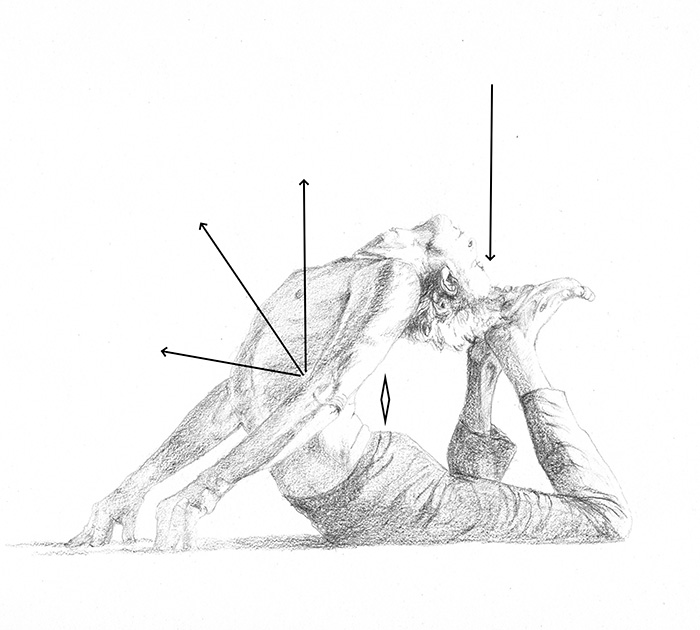
The Kundalini forces1)In the traditional yoga literature, Kundalini Shakti refers to a hidden mental or, to be more precise, spiritual force, often symbolically represented as a coiled serpent. Its awakening is connected with an expansion of the consciousness and spiritual development. are actually real spiritual thoughts that take hold of the body and carry it energetically. They transform the whole physicality, causing it to shine and bringing about an overall beautifying. In contrast to the purely vital dimensions, the vayu or various prana forces,2)Prana (Sanskrit: prāṇa) refers to life force or the breath of life. Vayu (vāyu) originally means wind or air. In yogic teachings, the various vayus are described as the various ways that life energy functions, for example, prana, apana, samana, udana and vyana. the Kundalini dimensions are freer from the body and therefore have the capacity to transform. For the practice of yoga, it is therefore important that all those striving for spiritual perfection, learn to distinguish whether all the energies that are perceptible energetically—in the sense of various types of prana—are released from a higher dimension or only from a lower one. In general, a sphere of influence can be spoken of that either originates from the spirit and permeates the human being, or conversely begins within the body and accompanies, or even occupies the consciousness. In general esoteric dialogue, a differentiation has developed between a movement from above to below or from below to above. This is one aspect of light influences, that a light from a free spiritual sphere touches and permeates the human being, or, on the other hand, a previously known perception from accumulated experiences is set free and rises up from below.
The significance of spiritual thoughts for yoga asanas.
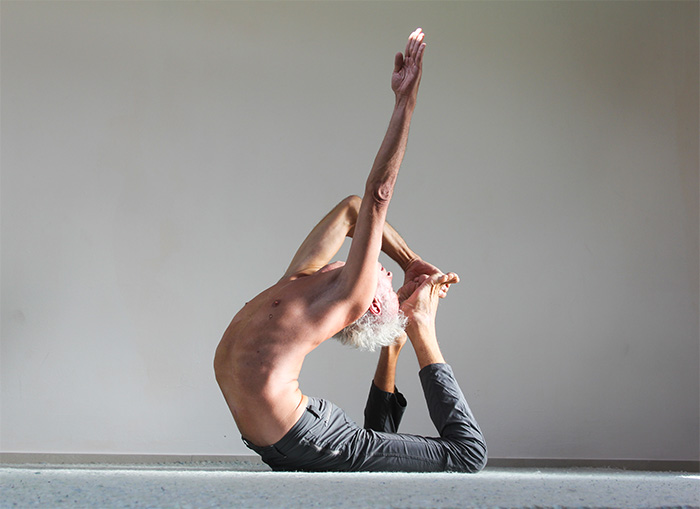
In some yoga schools it is understood that the asana exercises do not lead to any great spiritual value unless accompanied by content, mantras and further philosophical inquiry. The notion that the body alone cannot give rise to transformative, consciousness-shaping activity is accepted by many schools of yoga. The Kundalini work with yoga asanas needs the addition of appropriate spiritual thoughts for each asana, so that a higher dimension can conquer over a lower or previously familiar one. Having said this, in the practice a careful technical approach in building up the different relationships between tensions is very important because when these are not well chosen, the necessary calm that is needed for a transformative work3)Transformation here refers not only to a physical change, but the restructuring of the conditions of the body and the soul through spiritual, thought forces. The article explicitly distinguishes this concept from the mere activation of preexisting vital energies. cannot be developed. Higher dimensions can only reach into the physicality when there is a high degree of awareness, observation, and movements resulting from concentrated consciousness. For example, this work with asanas can be carried out as described below.




Anmerkungen
| ⇑1 | In the traditional yoga literature, Kundalini Shakti refers to a hidden mental or, to be more precise, spiritual force, often symbolically represented as a coiled serpent. Its awakening is connected with an expansion of the consciousness and spiritual development. |
|---|---|
| ⇑2 | Prana (Sanskrit: prāṇa) refers to life force or the breath of life. Vayu (vāyu) originally means wind or air. In yogic teachings, the various vayus are described as the various ways that life energy functions, for example, prana, apana, samana, udana and vyana. |
| ⇑3 | Transformation here refers not only to a physical change, but the restructuring of the conditions of the body and the soul through spiritual, thought forces. The article explicitly distinguishes this concept from the mere activation of preexisting vital energies. |